
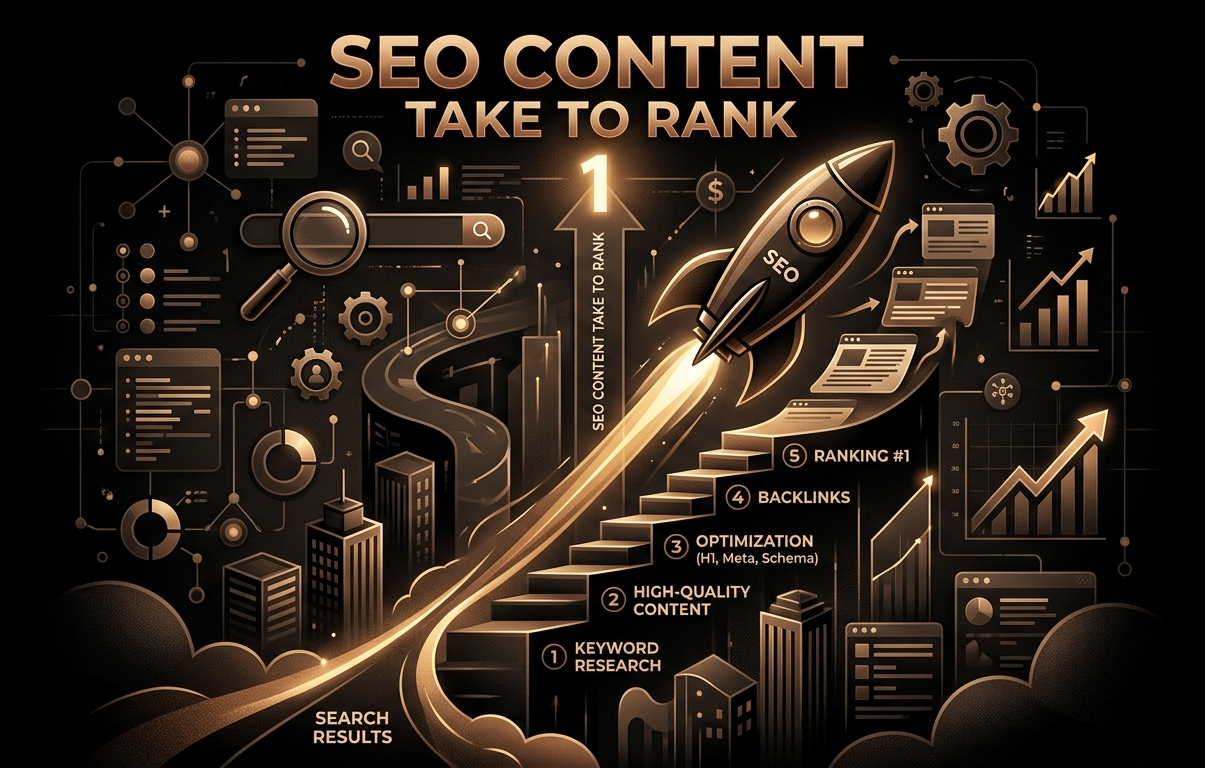
You’ve just published a new blog post. It feels like a big win. You expect calls, messages, or traffic right away. You keep checking Google—but your site is nowhere to be found.
This leads to the big question every business owner asks: how long does SEO content take to rank?
The honest answer? SEO takes time.
Unlike paid ads that deliver instant results, SEO works more like planting a tree. You nurture it, give it attention, and over time, it grows into something that can consistently bring customers to your business for years.
Many local business owners struggle with this. They launch a website, but it stays buried on page ten. That’s because Google needs time to build trust in your business. On top of that, your competitors may have been online for years, which means you must prove your credibility through consistent content and strong backlinks.
Another common mistake is inconsistency. If you post once and disappear, Google loses interest. To rank well, you need to publish content regularly to show both users and search engines that your business is active.
Understanding the SEO Timeline
The First 30 Days: The Crawl Phase
During the first month, Google crawls your website. It analyzes your content, structure, and code to understand what your business offers. At this stage, it’s normal to see little to no ranking movement.
The 60-Day Mark: The Testing Phase
Around the second month, your content may enter what many call the “sandbox.” Google starts testing your page by showing it to a small audience. It evaluates how users interact—whether they click, stay, or leave.
The 90-Day Turning Point
By the third month, you may begin to see progress. Your content might start ranking for long-tail keywords—more specific search phrases like “best gym for busy dads in my city.” This is where growth begins.
Why SEO Speed Varies
Several factors influence how quickly your content ranks:
- Website Age: Older, established sites tend to rank faster.
- Keyword Difficulty: Competitive keywords take longer—sometimes up to a year.
- Local Competition: Ranking in a large city is harder than in a smaller town.
What Helps You Rank Faster
Focus on Quality Content
Don’t create content just to fill space. Solve real problems. When your content helps people, they stay longer—and Google notices.
Key Ranking Factors
| Factor | Impact | Action Step |
|---|---|---|
| Site Speed | Very High | Optimize images and loading time |
| Backlinks | High | Get featured on local websites |
| User Intent | Medium | Answer questions clearly and quickly |
| Social Shares | Low | Share content on social platforms |
The Power of Local SEO
If you want faster results, focus on local keywords. Mention your city, nearby landmarks, and local events. This helps Google understand exactly where your business operates—giving you a competitive edge.
Building Trust with Data
Trust plays a huge role in rankings. Use real data and examples:
- Show project locations if you’re a contractor
- Share client results if you run a gym
- Provide real numbers and outcomes
The more proof you provide, the faster users (and Google) trust you.
How to Generate Leads While You Wait
Stop Waiting—Start Capturing Leads
SEO takes time, but that doesn’t mean you should sit idle. You need systems in place to capture every visitor.
The Tafuta Solutions Advantage
At Tafuta Solutions, we understand that businesses cannot afford to wait months for results. That’s why we build websites designed to generate leads from day one. Our systems track every visitor and help you convert them into customers without manual effort.
Steps to Scale Your Growth
- Audit Your Website: Identify and fix current issues
- Plan Your Content: Stay consistent with a content calendar
- Use Lead Magnets: Offer free value in exchange for contact details
- Track Performance: Measure results to improve continuously
Real Results for Real Businesses
Consider a business owner who was tired of spending money on ineffective marketing. After switching to a structured SEO system, they stopped guessing and started seeing measurable growth.
That’s the power of having a clear strategy.
The Technical Side of SEO
Mobile Optimization is Essential
Most users browse on mobile devices. If your site isn’t mobile-friendly, your rankings will suffer—no matter how good your content is.
Fix Broken Links
Broken links create a poor user experience and signal neglect to Google. Regularly check and update your links.
Use Internal Linking
Link your new content to older posts. This keeps visitors engaged and helps Google crawl your site more effectively.
Content Strategy for Local Growth
Consistent Blogging
Publishing regularly keeps your website relevant. Aim for 2–4 high-quality posts each month.
Use Real Images
Avoid generic stock photos. Use real images of your team, office, and work. Add keywords in image alt text to improve visibility.
Tell Your Story
People connect with people. Share your journey and mission. Authentic storytelling builds trust and loyalty.
The Role of Social Proof
Reviews Matter
Positive reviews are a strong ranking signal. The more 5-star reviews you have, the more trustworthy your business appears.
Ask for Reviews
Don’t hesitate to ask satisfied customers. A simple message with a direct link can make a big difference.
Use Case Studies
- Show real, measurable results
- Include visuals like charts or screenshots
- Demonstrate your expertise and credibility
Common SEO Myths
- SEO is a one-time task: It requires ongoing effort
- More words mean better ranking: Value matters more than length
- Keywords are everything: User experience is just as important
Your 6-Month SEO Roadmap
- Month 1: Fix technical issues and set up tracking
- Month 2: Publish four local-focused blog posts
- Month 3: Build local backlinks
- Month 4: Update and improve existing content
- Month 5: Focus on collecting reviews
- Month 6: Analyze performance and refine strategy
Why Systems Matter
Managing SEO alone can be overwhelming. A structured system allows you to focus on running your business while your marketing works in the background.
The Cost of Inaction
Every day you delay is a missed opportunity. Your competitors are already building their presence. The best time to start was yesterday—the next best time is now.
Conclusion
So, how long does SEO content take to rank?
In most cases, you’ll start seeing meaningful results within 3 to 6 months. However, success depends on consistency, quality, and strategy.
Instead of waiting, focus on building a strong brand, creating valuable content, and using systems that convert visitors into customers.
At Tafuta Solutions, we simplify the entire process. We remove the guesswork and help you grow your business with confidence—so you can focus on what matters most.
Frequently Asked Questions
Q1: How long does SEO content take to rank on Google?
Most content takes 3 to 6 months, depending on competition, website authority, and content quality.
Q2: Can local SEO rank faster?
Yes. Local keywords often face less competition and can show results within 60 days.
Q3: Does posting daily improve SEO?
Not necessarily. Posting 2–4 high-quality articles per month is more effective than frequent low-quality posts.
Q4: Why isn’t my content ranking?
Common reasons include technical issues, slow site speed, poor mobile design, or mismatched user intent.
Q5: Is SEO worth it for small businesses?
Absolutely. SEO delivers long-term results and continuous traffic without ongoing ad spend.